
The Invisible Practice: Why Your Dental Office Must Be in AI Search Results or Risk Extinction
A comprehensive analysis of the seismic shift from Google search to AI-powered recommendations, and why dental practices that fail to optimize for LLM inclusion face an existential threat to patient acquisition.
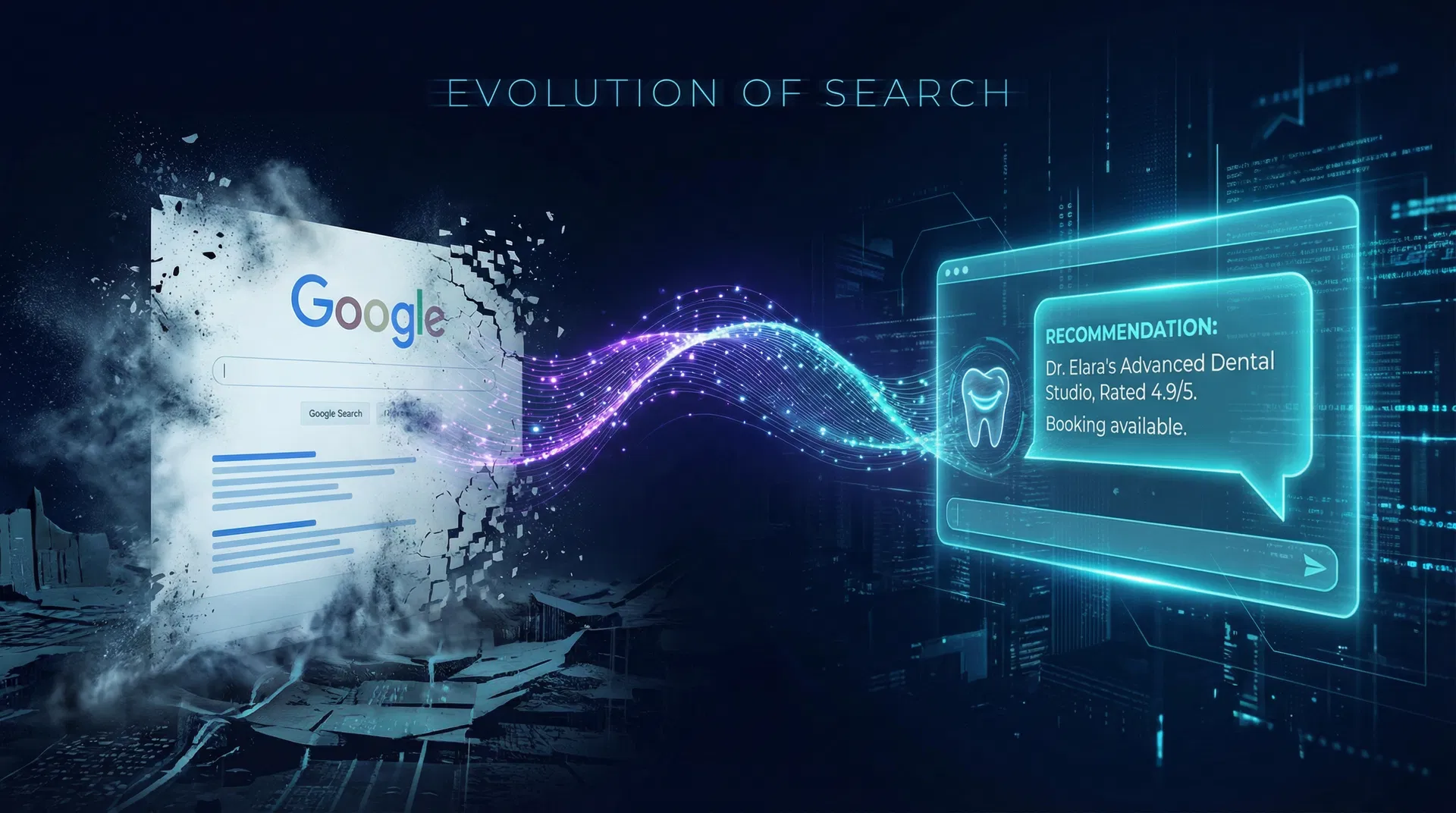
Table of Contents
Imagine this scenario. A potential patient in your city picks up their phone and says, "Hey ChatGPT, what's the best dentist near me for a family with young kids?" Within seconds, the AI responds with a confident, specific recommendation. It names a practice. It explains why that practice is ideal. It provides the phone number and a link to book an appointment.
Now here's the question that should keep every dental practice owner awake at night: Was your practice the one it recommended?
If you don't know the answer — or worse, if you suspect the answer is no — you are witnessing the single largest shift in patient acquisition since Google Maps launched the local pack in 2007. Except this time, the shift is far more binary. In the world of AI search, there is no page two. There is no "also consider." There is the recommendation, and there is everything else. And everything else is invisible.
This article is a comprehensive examination of why the transition from traditional search to AI-powered recommendations represents an existential inflection point for dental practices, what the data reveals about the speed of this transition, and precisely what practice owners must do to ensure they are on the right side of it.
The Paradigm Shift: From Searching to Being Told
For two decades, the patient acquisition funnel has followed a predictable pattern. A person types "dentist near me" into Google. They see a list of results — ads at the top, a map pack in the middle, organic results below. They click on several. They compare. They read reviews. They make a decision.
That model is dying.
What is replacing it is fundamentally different in a way that most dental professionals have not yet internalized. The new model does not present options. It presents answers. When a patient asks ChatGPT, Perplexity, Claude, or Grok for a dentist recommendation, the AI does not return a list of ten possibilities and say "here, you figure it out." It synthesizes thousands of data points — reviews, citations, structured data, authority signals, geographic relevance — and delivers a single, confident recommendation.
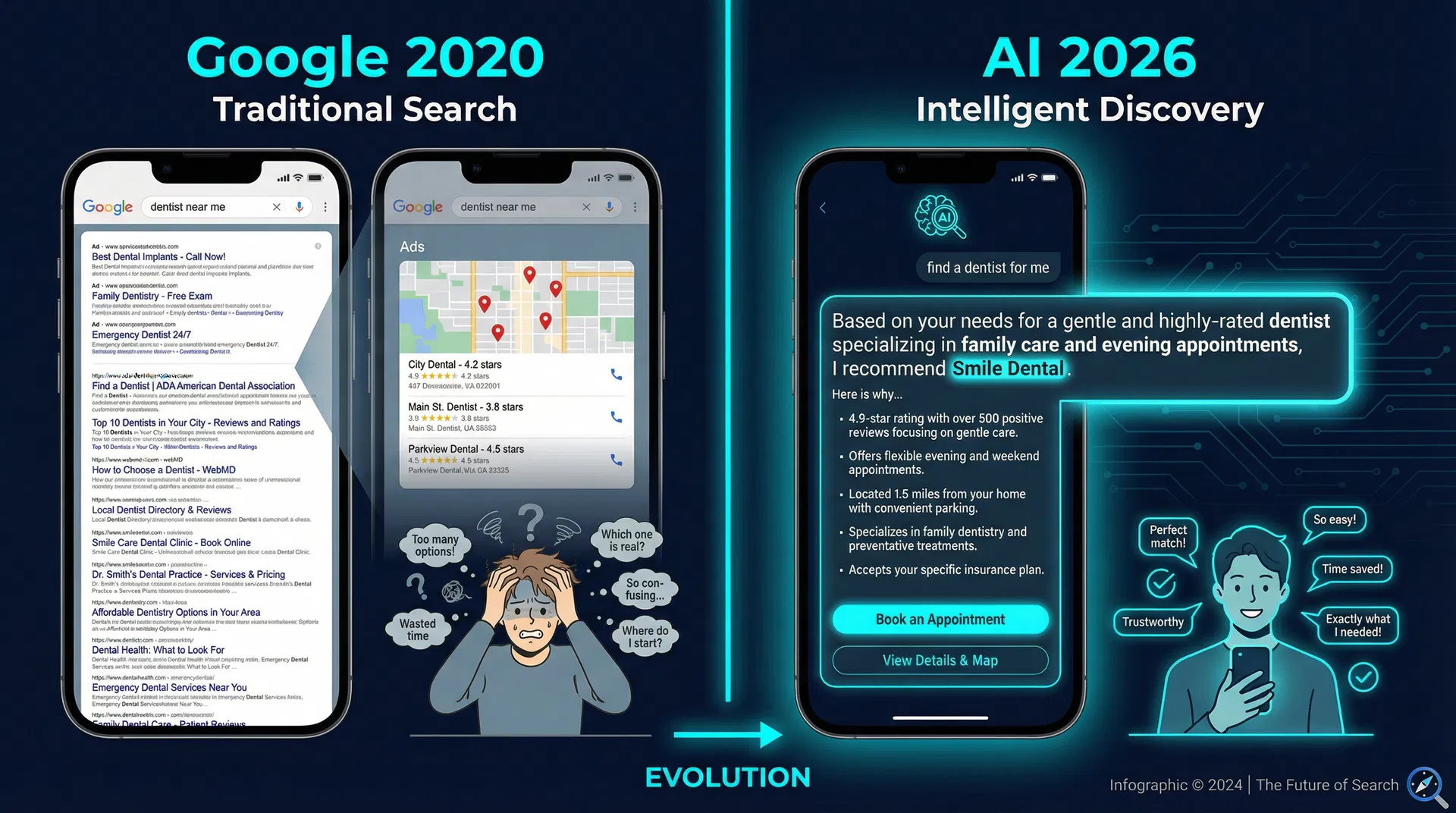
This is the critical distinction that separates the AI era from the Google era. Patients are no longer searching. They are being told. The psychological difference is enormous. When someone searches Google, they maintain agency — they evaluate, compare, and choose. When someone asks an AI, they are delegating that decision. They are trusting the AI to have already done the evaluation for them.
"The shift from search to AI is not an evolution of the same behavior. It is a fundamentally different cognitive act. Searching is active investigation. Asking AI is passive delegation."
And the data from a January 2026 study published by Search Engine Land confirms this behavioral shift is already well underway: 37% of consumers now start their searches with AI instead of Google. Among those users, 60% report that AI delivers better, clearer answers than traditional search. This is not a future prediction. This is the present reality.
The Numbers Don't Lie
The velocity of this transition is staggering. Consider the following data points, all sourced from industry research published in the last twelve months:
| Metric | Data Point | Source |
|---|---|---|
| AI Search Market Share | 12–15% of global search by end of 2025, up from 5–6% at start of year | PushLeads |
| Google AI Overviews | 50% of Google searches now include AI summaries; projected 75%+ by 2028 | McKinsey |
| ChatGPT Monthly Users | ~810 million monthly active users | SaaStr |
| Perplexity Growth | 450% growth between 2024 and early 2026; 800% annual growth rate | Incremys |
| Consumer AI Trust | 62% of consumers trust AI to guide brand decisions | Yext |
| AI vs. Ads Trust | AI search results are more trusted than paid advertising | Forbes |
| Google Market Share | Dipped below 90% for first time since 2015 | SaaStr |
| AI Citation Overlap | 80% of sources cited by AI platforms don't appear in Google's top results | GetPassionfruit |
That last statistic deserves special emphasis. Eighty percent of the sources that AI platforms cite when making recommendations do not appear in Google's traditional top ten results. This means that the practices currently winning on Google are not necessarily the ones winning in AI. It is an entirely different playing field with different rules, different ranking signals, and different winners.
Google's own behavior confirms the inevitability of this shift. The company has aggressively integrated AI Overviews into its search results, with Semrush reporting that approximately 16% of all Google queries now trigger an AI-generated summary at the top of the page. Even Google itself is acknowledging that the future of search is not a list of links — it is a synthesized answer.
The Invisible Practice Problem

Here is where the implications become deeply personal for dental practice owners. In the Google era, even if you were not on page one, you still existed. A determined patient could find you on page two, through a directory, via a friend's shared link. You were findable. You were discoverable. You had a chance.
In the AI era, there is no page two. When a patient asks ChatGPT for the best dentist in their area, the AI does not say "here are 50 options across 5 pages." It says "I recommend Practice X, and here's why." If your practice is not Practice X, you do not exist in that interaction. You are not second place. You are not an alternative. You are invisible.
This binary nature of AI recommendations creates a winner-take-most dynamic that is unprecedented in healthcare marketing. The practices that AI platforms consistently recommend will experience a compounding advantage: more patients lead to more reviews, which lead to stronger authority signals, which lead to more AI recommendations. It is a flywheel that, once spinning, becomes extraordinarily difficult for competitors to disrupt.
Conversely, practices that are absent from AI recommendations face a compounding disadvantage. As more patients shift to AI-first search behavior — and the data shows this shift is accelerating, not plateauing — the invisible practice loses an ever-growing share of potential new patients to the practices that AI does recommend.
The Extinction Scenario
A practice that is invisible to AI today is not just missing out on a few patients. It is being systematically excluded from the fastest-growing patient acquisition channel in history. With patient traffic expected to remain flat in 2026 and dental collections declining for many practices, the margin for error is razor-thin. Every patient you lose to an AI-recommended competitor is a patient you may never have the opportunity to win back.
Why LLM Optimization Is a Completely Different Game
If you have invested in traditional SEO — and you should have — you may be tempted to assume that your existing efforts will carry over to AI search. This assumption is dangerously wrong.
Traditional SEO is built on a foundation of keywords, backlinks, page speed, and technical optimization. These signals tell Google's algorithm that your website is relevant and authoritative for a given search query. The output is a ranking position on a results page.
LLM optimization operates on an entirely different logic. Large language models do not crawl the web in real-time and rank pages. They are trained on massive datasets and supplemented by retrieval-augmented generation (RAG) systems that pull from curated knowledge bases, structured data, citation networks, and real-time web sources. The signals that determine whether an LLM recommends your practice include:
The critical insight is that 80% of the sources AI platforms cite do not overlap with Google's top results. This means you could be ranking number one on Google for "best dentist in [your city]" and still be completely absent from ChatGPT's recommendations. The two systems are drawing from different wells of information, weighting different signals, and producing different winners.
The Anatomy of an AI Recommendation
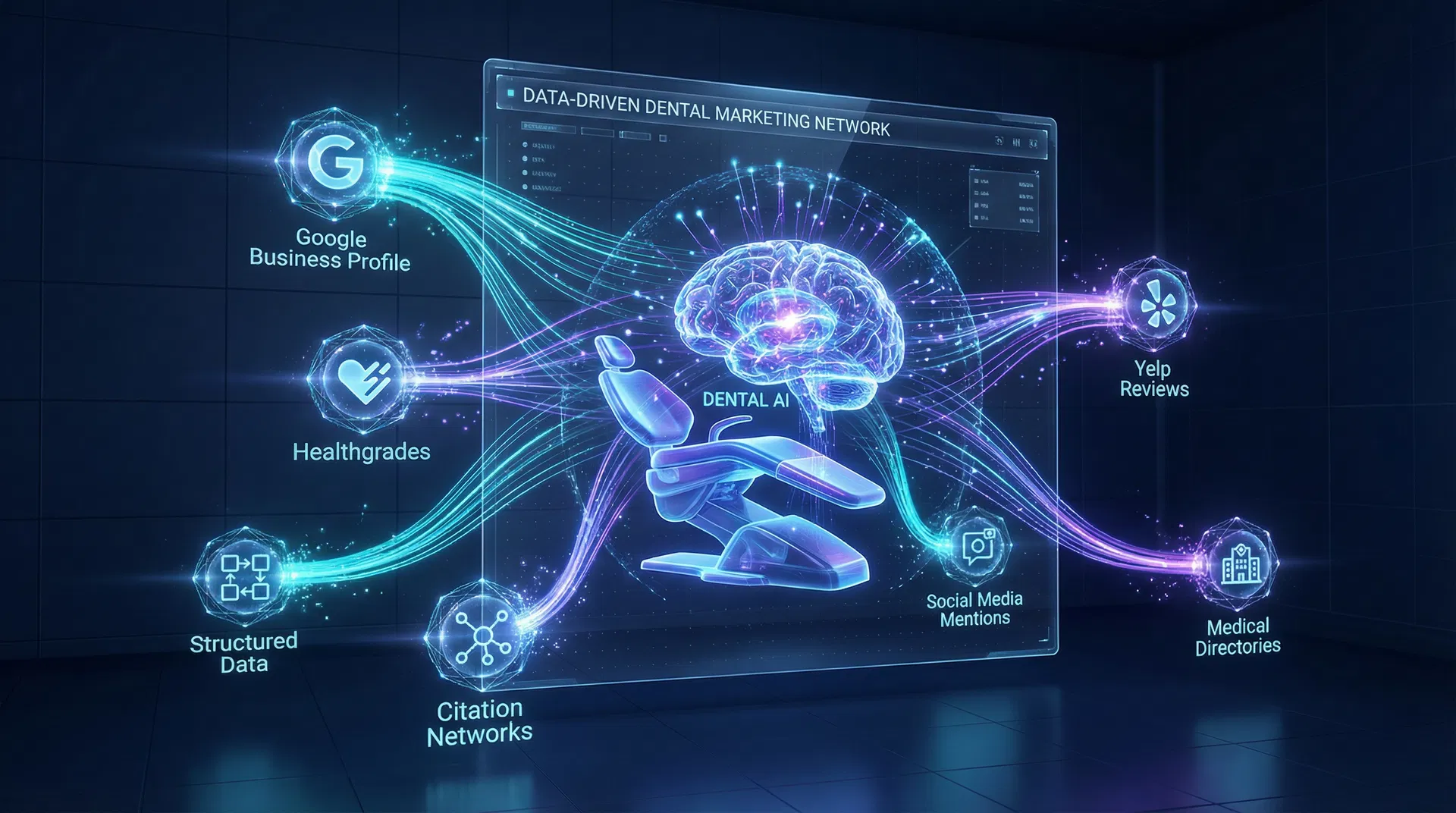
To understand how to influence AI recommendations, you must first understand how they are constructed. When a user asks an LLM "What's the best dentist near me?", the system executes a multi-step process that is far more sophisticated than a traditional search query.
Step 1: Entity Resolution
The AI first identifies what dental practices exist in the user's geographic area. It draws this information from structured databases, Google Business Profiles, healthcare directories like Healthgrades and Zocdoc, and its own training data. If your practice does not appear as a recognized entity in these systems, the AI literally does not know you exist.
Step 2: Signal Aggregation
For each identified practice, the AI aggregates signals from multiple sources. It analyzes review volume and sentiment across Google, Yelp, Healthgrades, and Facebook. It examines your website's structured data for services offered, accepted insurance, office hours, and specialties. It looks at citation consistency across directories. It evaluates the topical authority of your web content.
Step 3: Contextual Matching
The AI matches the aggregated signals against the user's specific query. If the user asked for a "family dentist with evening hours," the AI weights practices that have explicit signals for family dentistry and evening availability. This is where structured data becomes critical — if your website does not explicitly communicate these attributes in a machine-readable format, the AI cannot match you to the query.
Step 4: Confidence-Weighted Recommendation
Finally, the AI selects the practice it has the highest confidence in recommending. This confidence score is a function of signal volume (how much data exists about you), signal consistency (how uniform that data is across sources), signal quality (the sentiment and authority of your mentions), and signal recency (how current the information is).
The practice with the most consistent, comprehensive, and authoritative data footprint wins the recommendation. Every time.
Why the Dental Industry Is Uniquely Vulnerable
The dental industry faces a convergence of factors that make the AI search transition particularly consequential. Patient traffic and treatment volume are expected to remain flat in 2026. Growth is concentrated in specialty areas like oral surgery, while general dentistry faces increasing competitive pressure. Dental collections dropped for many practices in 2025, squeezing margins at precisely the moment when marketing effectiveness matters most.
In this environment, the practices that capture a disproportionate share of new patient acquisition will be the ones that thrive. And increasingly, that acquisition is happening through AI channels. Consider the patient journey: a young professional moves to a new city. Twenty years ago, they would ask a coworker for a recommendation. Ten years ago, they would Google "dentist near me." Today, they are increasingly likely to ask ChatGPT or Perplexity — and they trust the answer they receive.
The dental industry is also uniquely local, which amplifies the winner-take-most dynamic. When someone asks AI for a restaurant recommendation, there might be dozens of viable options. When they ask for a dentist, the AI is selecting from a much smaller pool of practices within a specific geographic radius. This means the competitive impact of being included — or excluded — from AI recommendations is proportionally much larger for dental practices than for many other local businesses.
The First-Mover Advantage Is Real — and It's Closing
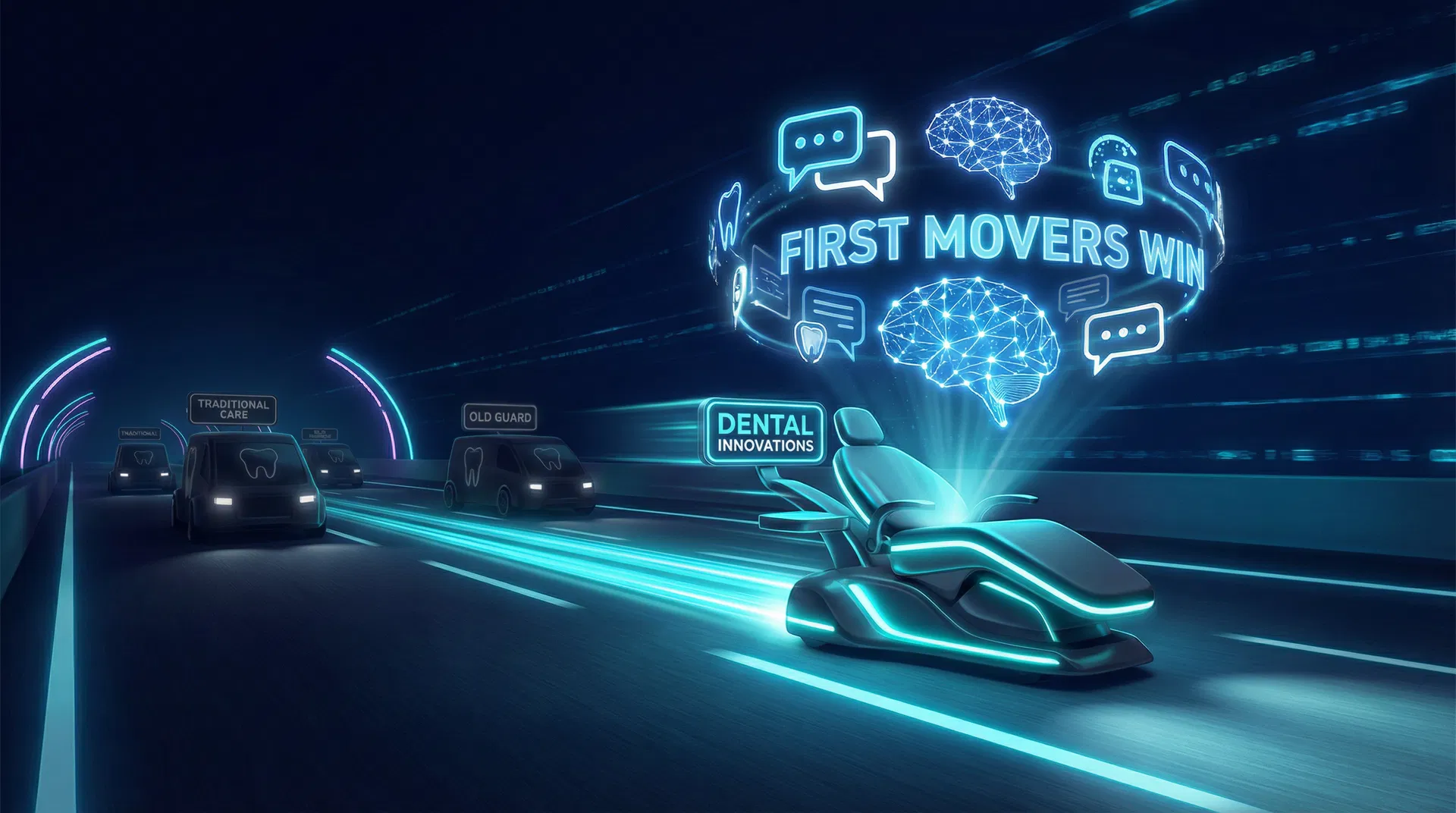
There is a window of opportunity that is open right now but will not remain open indefinitely. The vast majority of dental practices have not yet begun to optimize for AI search. They are still focused exclusively on traditional SEO, Google Ads, and social media marketing. This creates an asymmetric opportunity for early movers.
The practices that invest in LLM optimization today will build authority signals that compound over time. They will establish themselves as the recognized entities in their geographic markets. They will accumulate the citation density and structured data that AI systems rely on to make recommendations. And as AI search volume continues its exponential growth trajectory, these early movers will capture a disproportionate share of the new patient flow.
The compounding nature of this advantage cannot be overstated. Once an AI system consistently recommends your practice, that recommendation generates more patients, more reviews, more mentions, and more data — all of which reinforce the AI's confidence in continuing to recommend you. Breaking into this cycle as a latecomer requires significantly more investment and time than establishing the position in the first place.
The Compounding Effect
Early adopters of LLM optimization are already seeing 200–400% increases in AI visibility scores within 90 days. As these practices accumulate more patients and reviews from AI-driven referrals, their advantage compounds — making it exponentially harder for latecomers to displace them. The cost of waiting is not linear. It is exponential.
Your 90-Day Action Plan
Understanding the problem is necessary but insufficient. What follows is a concrete, prioritized action plan that dental practices can begin implementing immediately to establish their presence in AI search results.
Foundation & Audit
- Conduct an AI visibility audit: ask ChatGPT, Perplexity, Claude, and Grok for dentist recommendations in your area and document whether your practice appears
- Audit NAP consistency across all directories, review sites, and data aggregators — fix every discrepancy
- Implement comprehensive Schema.org structured data on your website (LocalBusiness, Dentist, MedicalOrganization schemas)
- Claim and optimize profiles on all major healthcare directories: Healthgrades, Zocdoc, Vitals, WebMD, RateMDs
Authority Building
- Launch a systematic review generation campaign focused on detailed, descriptive reviews (not just star ratings)
- Publish 4–6 pieces of authoritative dental content optimized for AI citation (long-form, well-sourced, structured with clear headings)
- Build citation density through mentions in local news, dental associations, community organizations, and industry publications
- Ensure your Google Business Profile is fully optimized with all attributes, Q&A, and regular posts
Optimization & Monitoring
- Re-audit AI visibility across all major LLM platforms and measure improvement
- Implement ongoing monitoring to track when and how AI platforms mention your practice
- Optimize content based on the specific queries that AI platforms are answering about dental services in your area
- Establish a recurring process for maintaining citation accuracy, generating reviews, and publishing authoritative content
The Bottom Line
The transition from Google search to AI-powered recommendations is not a theoretical future scenario. It is happening now, it is accelerating, and it is reshaping how patients find and choose dental providers. The data is unambiguous: AI search tools captured 12–15% of global search market share by the end of 2025, 37% of consumers already start searches with AI, and 62% trust AI to guide their brand decisions.
For dental practices, the implications are existential. In a market where patient traffic is flat, collections are declining, and competition is intensifying, the practices that AI platforms recommend will capture a disproportionate and growing share of new patients. The practices that AI platforms do not recommend will face an accelerating decline that becomes harder to reverse with each passing quarter.
The window for establishing a first-mover advantage in AI search is open today. It will not remain open indefinitely. As more practices recognize this opportunity and begin optimizing, the competitive landscape will shift from "easy to enter" to "expensive to catch up." The cost of action today is a fraction of the cost of action two years from now.
The question is not whether AI will become the primary way patients find dentists. The data has already answered that question. The only question is whether your practice will be the one AI recommends — or the one it doesn't know exists.
Find Out If AI Knows Your Practice Exists
Get a free AI visibility audit. We'll query every major LLM platform for dental recommendations in your area and show you exactly where you stand.
Sources & References
PushLeads — "The State of AI Search in 2025"
McKinsey — "New Front Door to the Internet" (Oct 2025)
GetPassionfruit — "AI Search vs Traditional Clicks" (Nov 2025)
Semrush — "AI Overviews' Impact on Search" (Dec 2025)
Incremys — "Perplexity AI 2026 Statistics" (Jan 2026)
FirstPageSage — "Top Generative AI Chatbots" (Feb 2026)
Search Engine Land — "37% Start Searches with AI" (Jan 2026)
Yext — "AI Search Gains Consumer Trust" (Jul 2025)
Forbes — "AI Results More Trusted Than Ads" (Mar 2025)
SaaStr — "Google: AI Hasn't Hurt Search" (2025)